

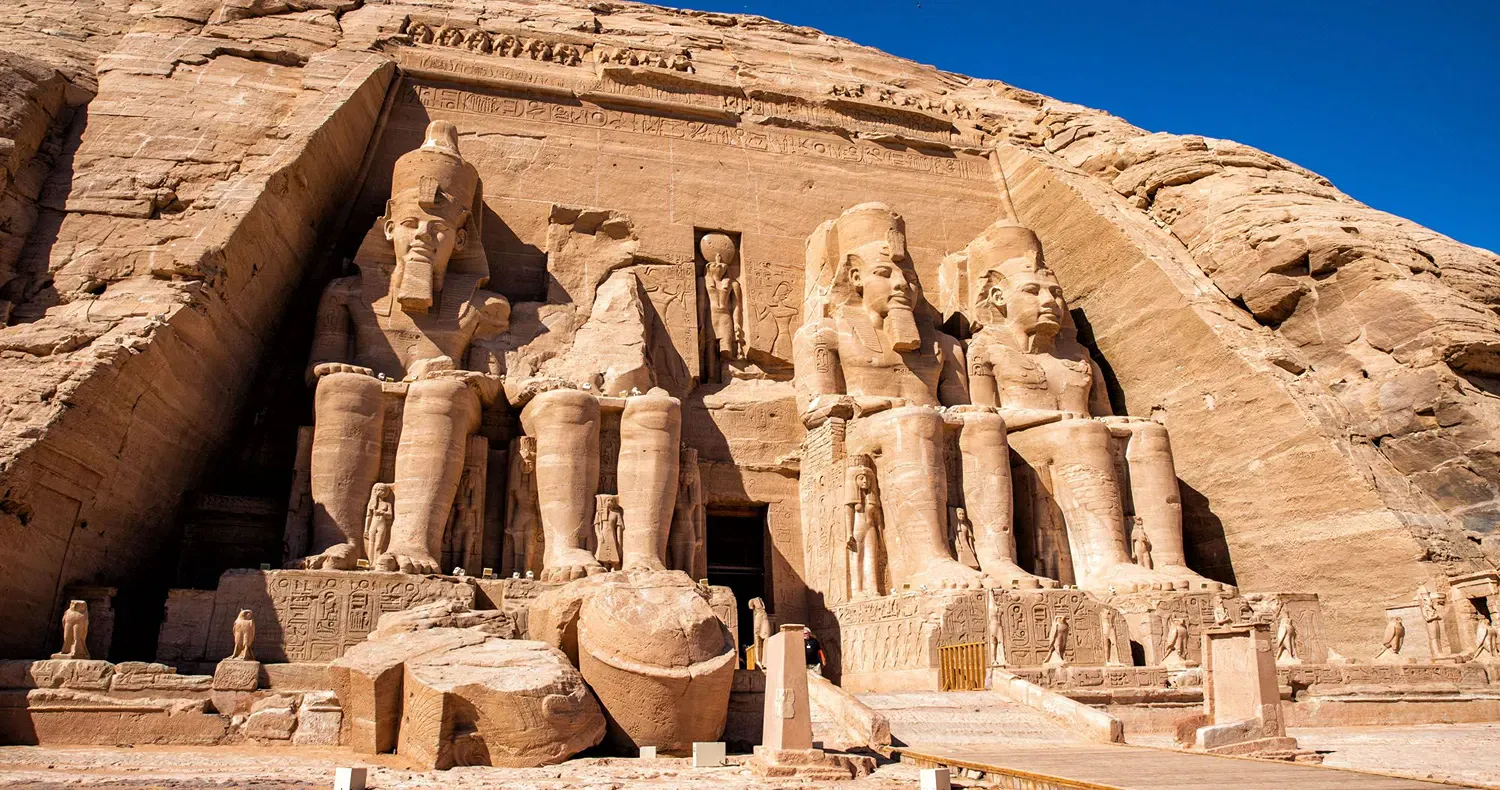
Abu Simbel is the most remote of Egypt's great monuments and, for many expats here, the one that justifies a dedicated trip south. It stands near the Sudanese border on Lake Nasser, about a 3–4 hour drive or a short flight from Aswan, which is itself a flight or overnight train from Cairo.
What you're looking at
Pharaoh Ramesses II carved these two temples straight into the rock in the 13th century BC — the Great Temple fronted by four 20-metre seated statues of himself, and the smaller temple dedicated to his queen Nefertari and the goddess Hathor. The interiors are covered with scenes of Ramesses' reign and the Battle of Kadesh.
What makes Abu Simbel doubly remarkable is that it was moved. In the 1960s, as the Aswan High Dam created Lake Nasser, a UNESCO-led project cut the temples into blocks and reassembled them 65 metres higher up — preserving the original alignment that lights the inner sanctuary twice a year.
Visiting as a resident
Most people go by an early convoy or the short flight from Aswan, arriving in the morning before the heat and the day-tripper coaches. Two to three hours is enough to see both temples properly. It pairs naturally with a few days in Aswan and a Nile stretch taking in Philae and Kom Ombo.
Good to know
- Best months are November to February; this is one of the hottest corners of Egypt.
- The twice-yearly sun alignment (around late February and October) draws big crowds.
- A flight from Aswan turns it into a half-day; the road convoy is cheaper but long.
- Bring water, sun cover, and cash for extras.
Related
- Living in Egypt — the full expat guide
- Getting around in Egypt — flights, trains, and Nile logistics
- Temple of Kom Ombo — a riverside temple near Aswan