

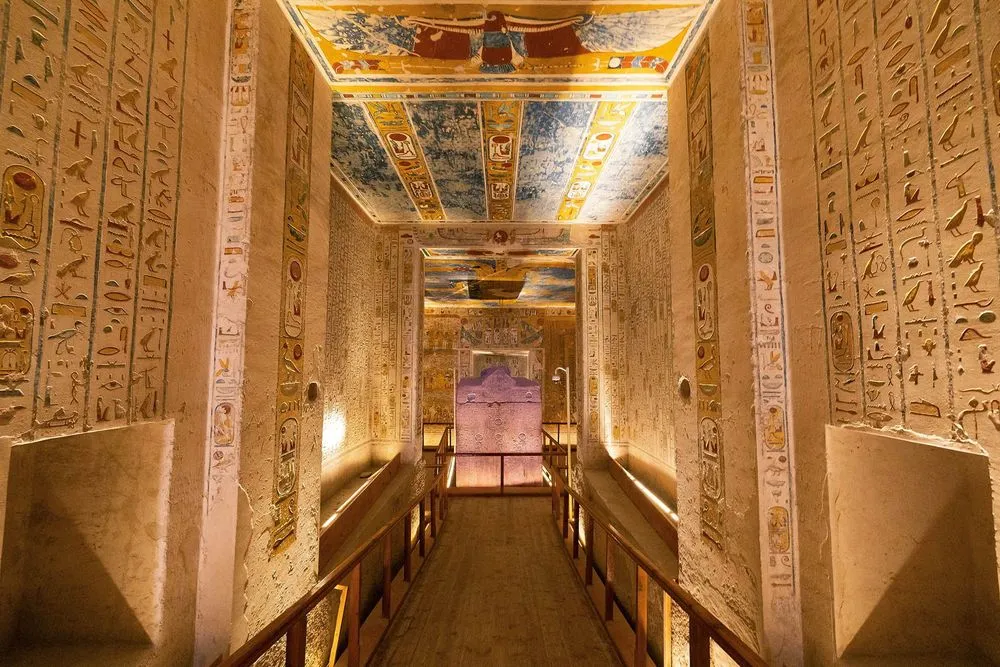
For expats in Egypt, the Valley of the Kings is the centrepiece of a trip to Luxor — the sort of long weekend you will almost certainly do at least once while living here, and probably again when visitors arrive. It sits on the west bank of the Nile opposite Luxor, about a 1.5-hour flight or an overnight train from Cairo.
What you're looking at
This desert valley was the burial ground for pharaohs of the New Kingdom, from around 1550 BC. Its secluded, cliff-ringed setting was chosen to hide and protect the tombs. More than sixty tombs have been found here, cut deep into the rock and covered in painted scenes from Egyptian funerary texts. The best known belong to Tutankhamun (KV62, found largely intact by Howard Carter in 1922), Seti I (KV17, one of the longest and most finely decorated), and Ramesses VI (KV9, famous for its astronomical ceiling).
Visiting as a resident
A general ticket lets you into three tombs from those currently open; a few — including Tutankhamun's, Seti I's, and Nefertari's in the nearby Valley of the Queens — need separate tickets. Which tombs are open rotates, so check on the day rather than fixing your heart on one.
Go early: the valley bakes by mid-morning and shade is almost non-existent. A photography pass is needed for cameras inside most tombs. Most people combine the visit with the Temple of Hatshepsut at Deir el-Bahari and the temples across the river, which makes a two-day Luxor trip more sensible than a rushed day.
Good to know
- Best months are November to February; summer is extreme.
- Wear proper shoes — the ground is uneven and the tomb ramps are steep.
- Buy the extra ticket for at least one "premium" tomb; the difference in decoration is worth it.
- Reaching Luxor is easy by domestic flight or sleeper train from Cairo.
Related
- Living in Egypt — the full expat guide
- Getting around in Egypt — flights, trains, and getting to Luxor
- Temple of Kom Ombo — an easy stop on the Nile between Luxor and Aswan