

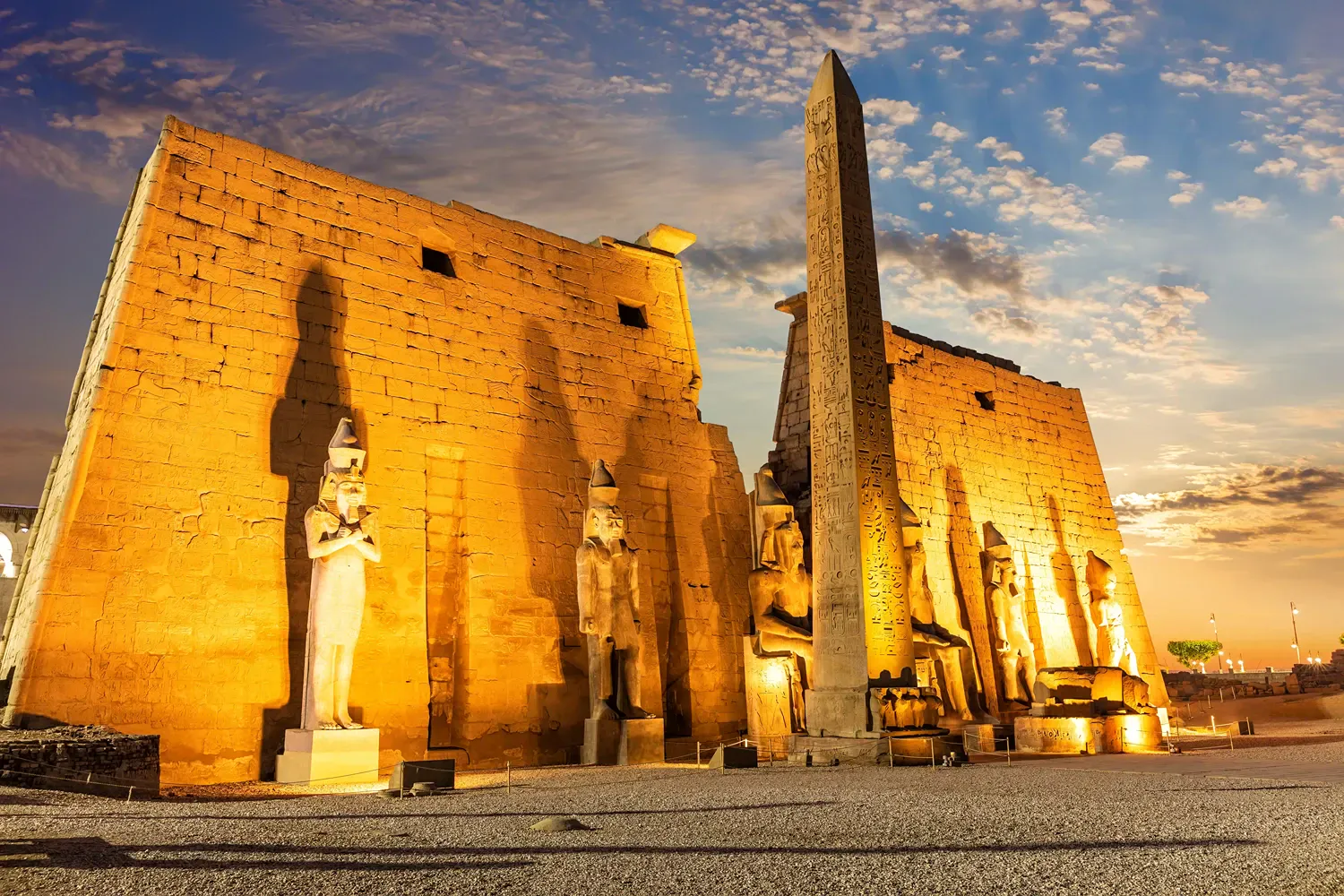
Luxor Temple sits right in the middle of modern Luxor, on the east bank of the Nile — which makes it one of the easiest major monuments to visit, and one of the best after dark. For expats spending time in Luxor, it's an evening stroll rather than an expedition.
What you're looking at
Built mainly by Amenhotep III and Ramesses II from around 1400 BC, Luxor Temple was dedicated to the Theban gods and was the focus of the great annual Opet Festival. Its colossal statues of Ramesses II, a surviving obelisk, and a grand colonnade of towering columns are the standouts. Layers of later history are visible too — a Roman chapel, a Christian church, and a still-active mosque built into the complex.
Visiting as a resident
Because it's central and walkable, Luxor Temple is easy to fit in around other plans. It's especially worth seeing in the evening, when the whole site is floodlit and cooler. Pair it with Karnak, to which it was once linked by the restored Avenue of Sphinxes.
Good to know
- Best months are the cooler November to February.
- Go after dark for the atmosphere and the lighting.
- It's compact — an hour or so is plenty.
- Combine with Karnak and the west-bank tombs for a full Luxor stay.
Related
- Living in Egypt — the full expat guide
- Getting around in Egypt — flights, trains, and getting to Luxor
- Karnak Temple — the vast temple complex just to the north
- Valley of the Kings — the royal tombs across the river